
Read your analysis in three steps
Three models read every official EuroJackpot draw. The page lays out their analytical outputs in one place, so you can interpret the analytical outputs with the full picture in front of you.
Science · Method · Evidence.
Press “Run Analysis”
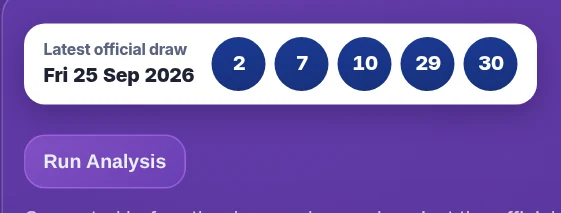
The latest official draw loads by itself in the white box. The button sits right under it. Your analytical outputs appear in a few seconds, built from the full EuroJackpot record up to that draw.
Read the five outputs
Under the button, your run is laid out under five labels. These are the main outputs of every run. Each list sits in zone rows, 1–9, 10–19, 20–29, 30–39 and 40–50, and a number always keeps the same place, so you can compare the lists at a glance. Every number is shown as the same blue ball: a list tells you which numbers it holds, and none of them is marked out by colour.
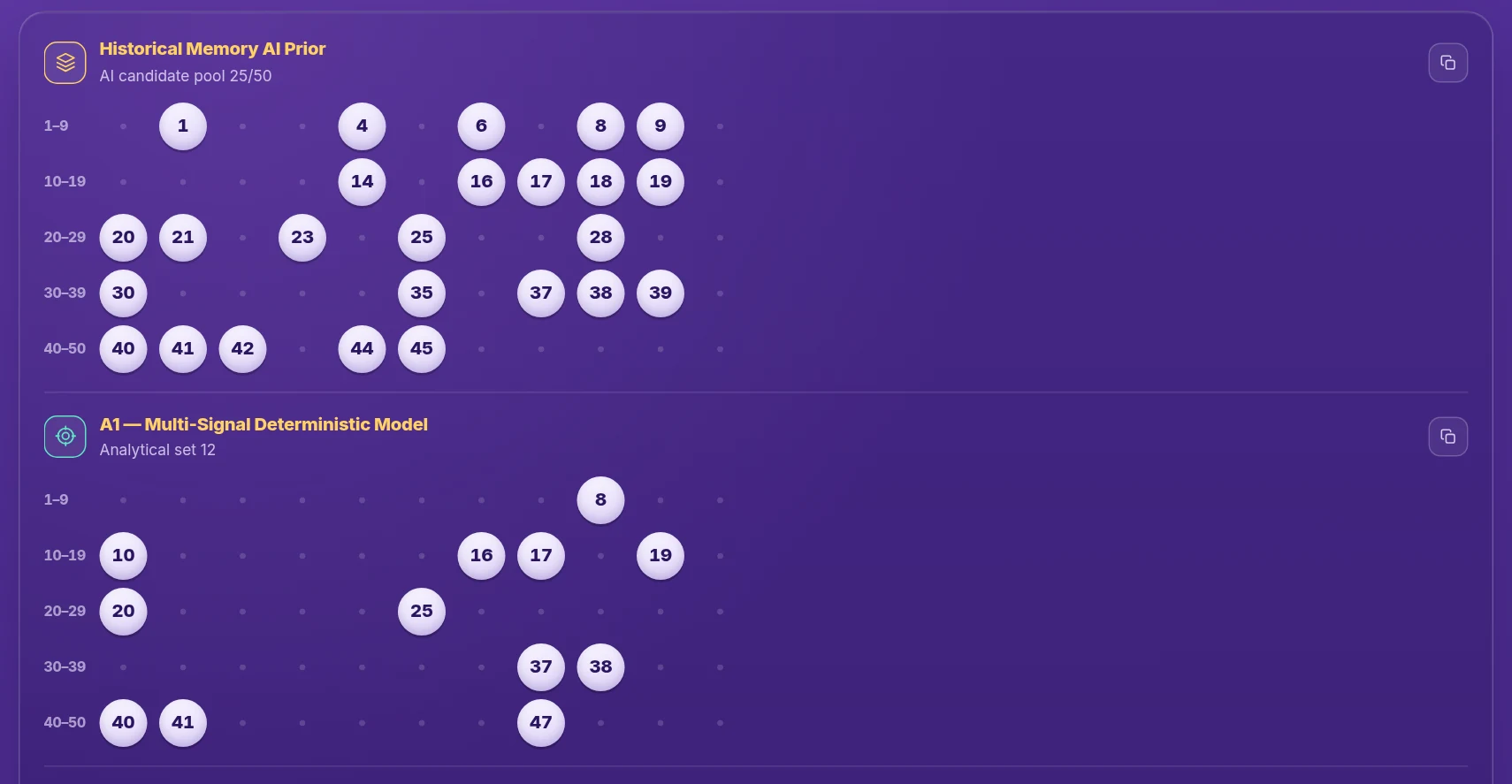
Tap any number and it lights up in every list, so you see at once where it belongs. The copy button beside each label copies that list.
-
Historical Memory AI PriorAI candidate pool 25/50
A trained memory layer reads the complete record and narrows the fifty numbers to a ranked pool of 25. The three models use it as their guide.
-
A1 — Multi-Signal Deterministic ModelAnalytical set 12
The balanced analytical set. It weighs how often and how recently each number has been drawn.
-
A2 — Deterministic ModelAnalytical set 12
The constrained analytical set. It reads which numbers appear together and follow each other, with a tighter spread.
-
A3 — Zone Markov learnerAnalytical set 12
The exploratory analytical set. It reads how numbers move between the zones of the board from draw to draw.
-
Unique numbers (35)
The AI candidate pool, plus the numbers A1, A2 and A3 add outside it, taken in that order up to 35 numbers in total. It is the widest view on the page.
Interpret the analytical outputs
A simple way to read any run.
Start with the AI candidate pool
The Historical Memory AI Prior is the field the three models work from. In this run it holds 25 of the fifty numbers.
Compare the three readings
A1 is the balanced reading, A2 the constrained one and A3 the exploratory one. Tap a number to see which of the lists hold it. Where they differ, the descriptions above explain why.
Check the spread
The zone rows show how the numbers of each list sit across the board, from 1–9 to 40–50.
Use Unique numbers for the widest view
It brings the four lists above it together, each number once, up to 35 numbers. In this run it holds 35.
Scientific analysis workspace
Under the outputs, the workspace brings every model output and its record together. It works in four steps.
Step 1. Review a model output and its record. Each card is one model output: Historical Memory AI Prior, A1, A2, A3 and Unique numbers. The large figure is the size of its current draw analysis; the line beneath it is its record across your scored runs. Select a card to open that record. Every saved run is scored against the official draw that followed it: the drawn numbers the output held turn gold, the rest stay empty, and the score sits on the right. A run still awaiting its draw is marked with a gold pulse and is scored automatically once the draw is published. Until your first run is scored, the record shown is the public Tychefy record from the History page.

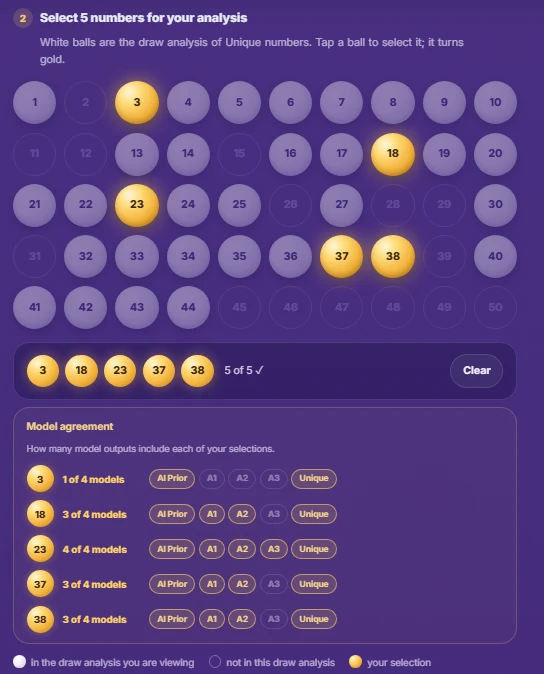
Step 2. Select 5 numbers for your analysis. White balls are the draw analysis of the output you selected; empty balls lie outside it. Tap a ball and it turns gold; once five are selected, the remaining balls dim. Your selections collect in the bar beneath the board, and Model agreement shows, for each of them, how many of the four models (Historical Memory AI Prior, A1, A2 and A3) include it and which outputs carry it.
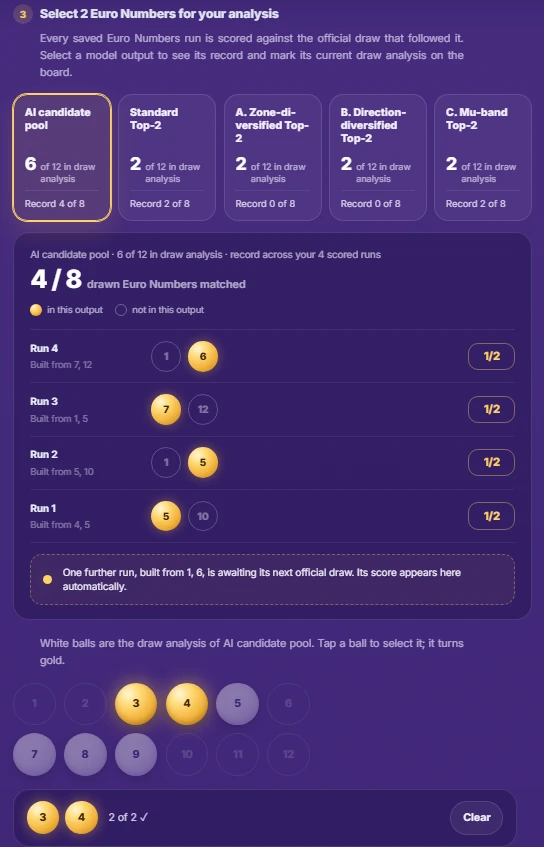
Step 3. Select 2 Euro Numbers. The Euro Numbers follow the same method, with their own five outputs and record: AI candidate pool, Standard Top-2, A. Zone-diversified Top-2, B. Direction-diversified Top-2 and C. Mu-band Top-2.
Step 4. Build your analysis set. Add the selection to your analysis set, where your numbers and Euro Numbers appear in gold. Copy the set when you are done.
Your runs, scored
My saved runs
Every run is saved automatically and privately, and your five most recent stay under My saved runs. Select one and it opens exactly as it was saved, in the same form as the live run. Once the next draw is published, its numbers appear under Next draw and turn yellow in every list. The figure beside each label, such as 1/5, shows how many of the drawn numbers that list held. Hide result shows the run exactly as it was before the draw. The raw output under it holds the same run as text, ready to copy.
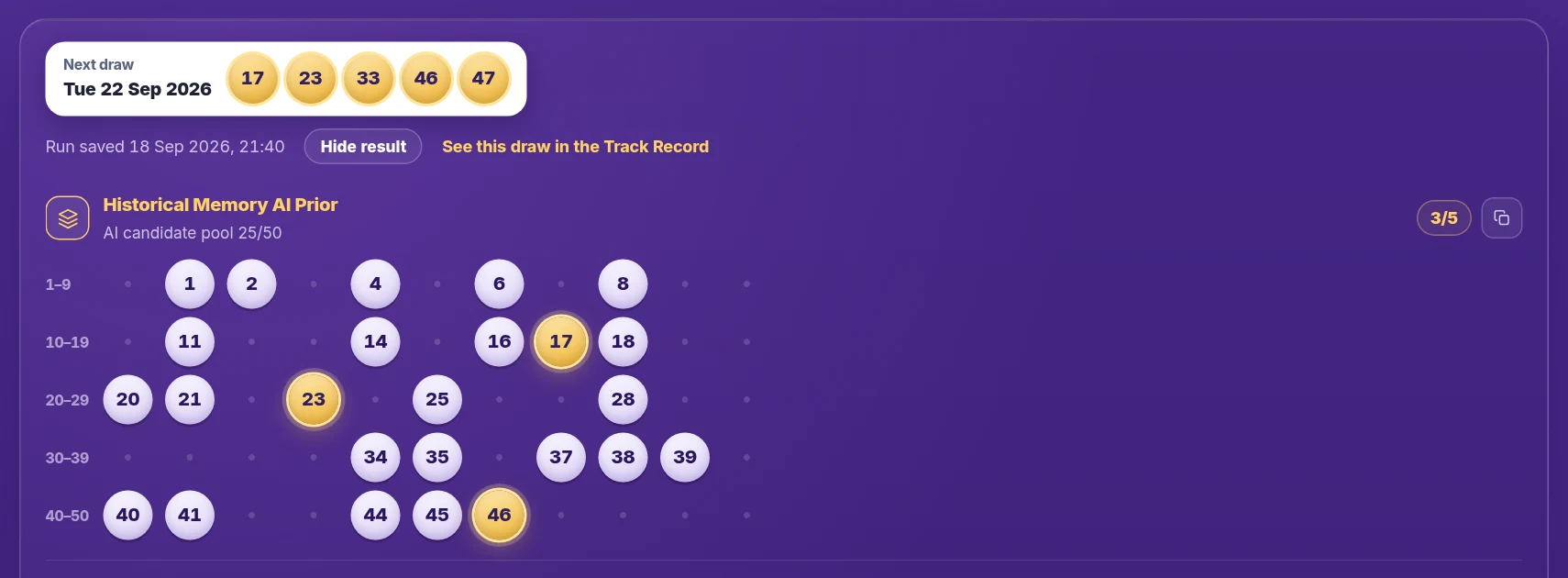
Model performance
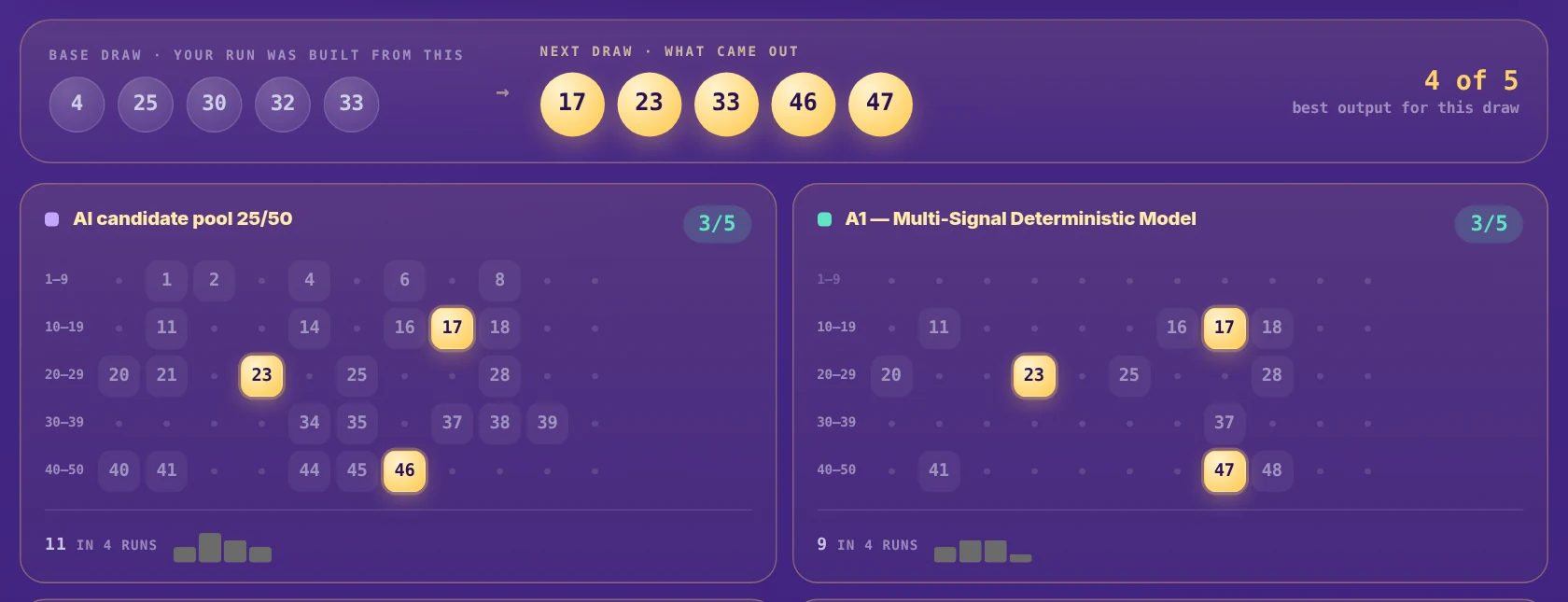
Each saved run is scored automatically against the draw that followed it. Yellow tiles are the numbers that came out, and the score sits top right of each output.
- Base draw · the draw your run was built from.
- Next draw · the draw that came out after it.
- Best output · the highest score among the scored outputs.
Across your saved runs puts every scored run in one table, and the last row adds them up. Select a row to open that run above. Your newest run joins the table once its next draw is published.
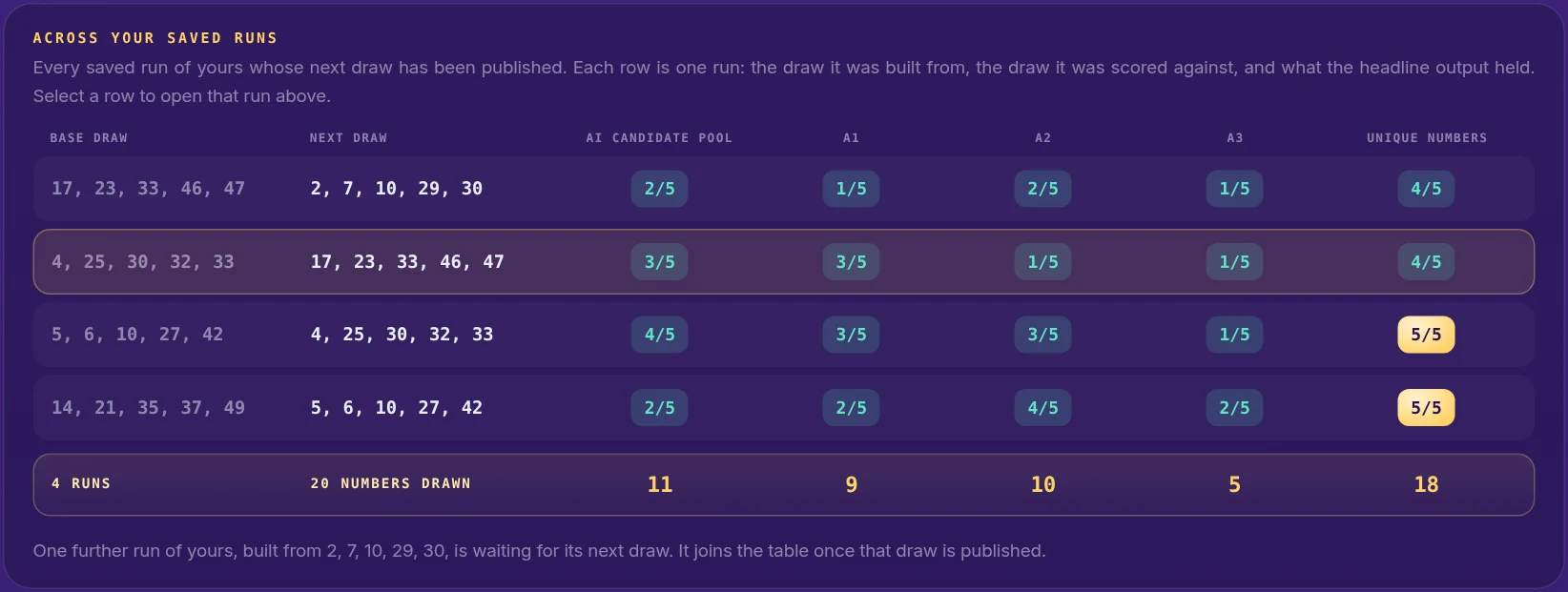
Just started? A run is scored once the draw after it is published, so the panel fills in one draw at a time.
Ready when you are
Looking for the two Euro Numbers? They have their own page and guide: Euro Numbers · guide.
Open EuroJackpot v.1 →Other guides: EuroMillions v.1 · EuroMillions v.2 · Lucky Stars · EuroJackpot v.2 · Euro Numbers