
Read your analysis in three steps
One model reads the complete EuroMillions record for the twelve Stars and gives you four ways of reading it. The page lays them out side by side, so you can interpret the analytical outputs with the full picture in front of you.
Science · Method · Evidence.
Press “Enter for Lucky Stars”
The latest official Stars and their draw date load by themselves in the white box. The button sits right under it. Your results appear in a few seconds, built from the full EuroMillions record up to that draw.

Read the five outputs
Under the button, your run is laid out under five labels. These are the main outputs. The AI candidate pool comes first, and the four Top-2 views sit under it, each giving you a pair read in its own way. Every star is shown as the same white ball, and none of them is marked out by colour.
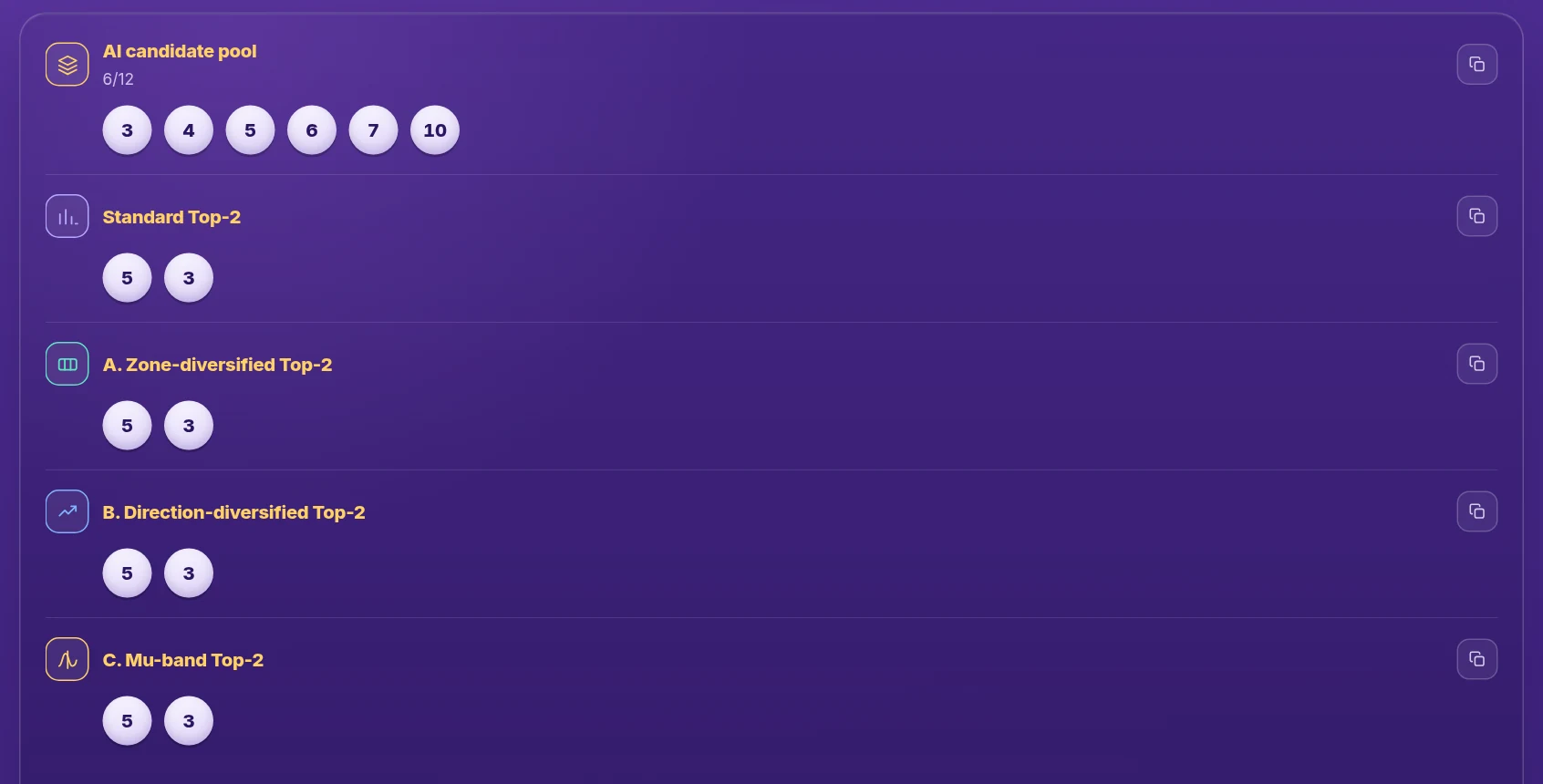
Tap any star and it lights up in every output, so you see at once where it belongs.
-
AI candidate pool6/12
The candidate pool retained by the model for analytical comparison. The four views are drawn from it.
-
Standard Top-2
The direct reading: the two highest-scoring numbers, with no further constraint.
-
A. Zone-diversified Top-2
Spreads the pair across the low, middle and high bands of 1–12, so the two do not sit in the same part of the board.
-
B. Direction-diversified Top-2
Favours movement away from what just came up.
-
C. Mu-band Top-2
Combines ranking strength with a stabilisation layer, so the view stays coherent as new draws arrive.
Interpret the analytical outputs
Each view already gives you a pair. A simple way to compare them is shown here with this run.
Start with the pool
The AI candidate pool holds the six Stars the model retains out of twelve. In this run: 3, 4, 5, 6, 7, 10.
Compare the four pairs
In this run all four views give the same pair, 3 and 5. Where the views differ, the four descriptions above explain why.
Check them against the pool
Every pair in this run sits inside the pool.
Your runs, scored
My saved runs
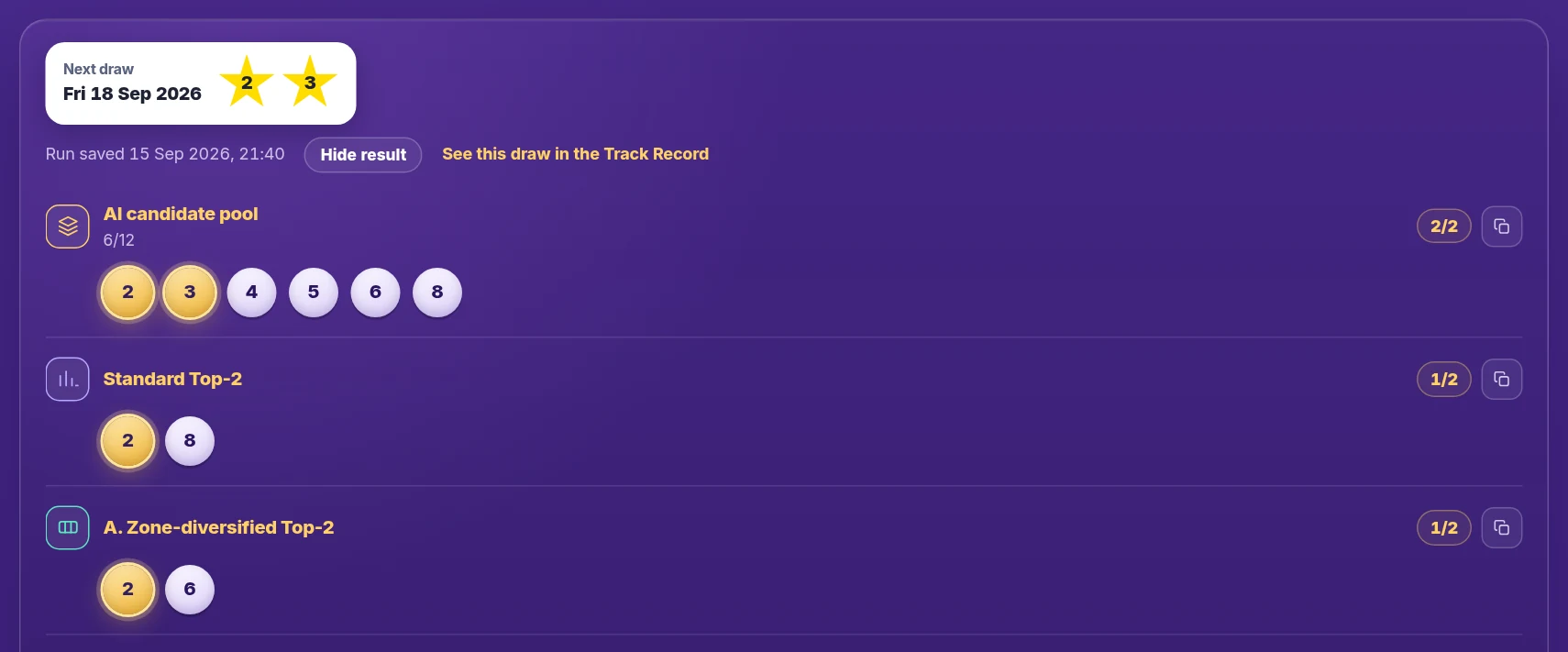
Every run is saved automatically and privately, and your five most recent stay under My saved runs. Select one and it opens exactly as it was saved, in the same form as the live run. Once the next draw is published, its Stars appear under Next draw and turn yellow in every list. The figure beside each label, such as 1/2, shows how many of the drawn Stars that list held. Hide result shows the run exactly as it was before the draw. The raw output under it holds the same run as text, ready to copy.
Model performance
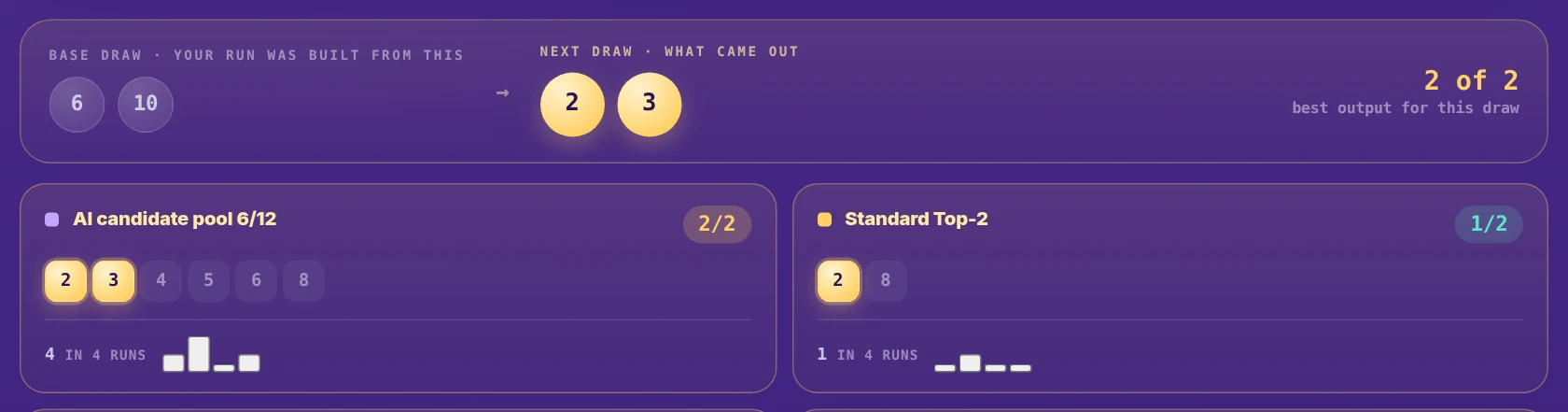
Each saved run is scored automatically against the draw that followed it. Yellow tiles are the Stars that came out, and the score sits top right of each output.
- Base draw · the draw your run was built from.
- Next draw · the draw that came out after it.
- Best output · the highest score among the scored outputs.
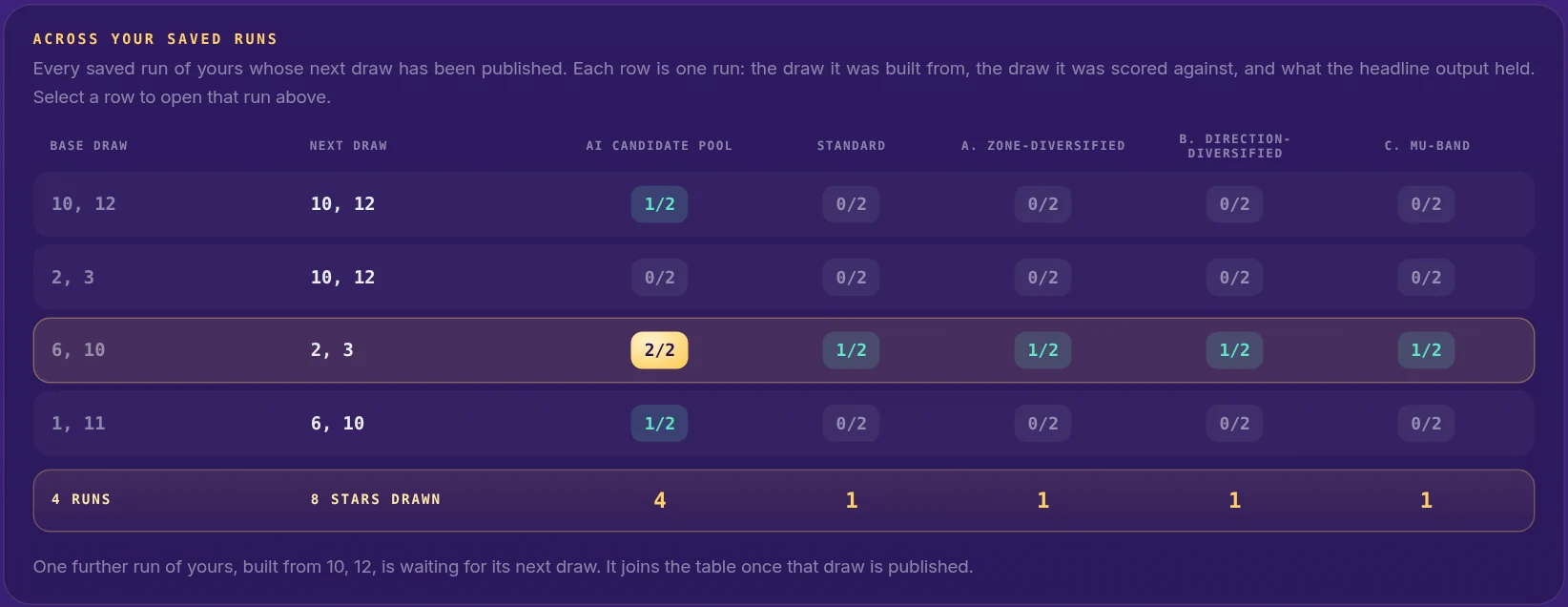
Across your saved runs puts every scored run in one table, and the last row adds them up. Select a row to open that run above. Your newest run joins the table once its next draw is published.
Just started? A run is scored once the draw after it is published, so the panel fills in one draw at a time.
Ready when you are
The five main numbers have their own pages and guides: EuroMillions v.1 · guide and EuroMillions v.2 · guide.
Open Lucky Stars →Other guides: EuroMillions v.1 · EuroMillions v.2 · EuroJackpot v.1 · EuroJackpot v.2 · Euro Numbers